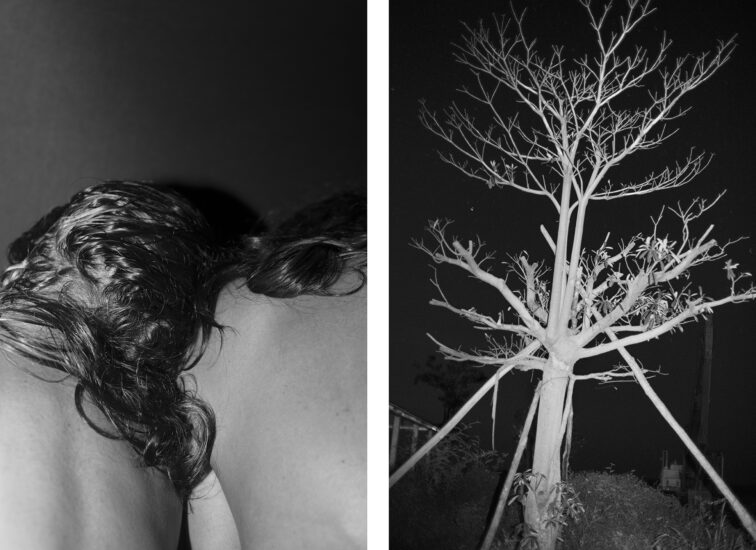
Images by Priyadarshini Ravichandran, from the series "Surge"
Archive Frictions is a knowledge exchange project centered on the co-creation, circulation, and application of knowledge between universities, museums, artists, archivists, curators, students and public audiences in the UK and India. Rather than producing research in isolation, the project unfolds through iterative cycles of exchange. At the heart of this project is a remarkable set of photographs discovered by Fast Forward PhD researcher Alexandra Gow in the archives of National Galleries of Scotland believed to have been taken in India in the early to mid-1900s. In contrast to the many stereotypical depictions of India present, this collection stands out for its focus on women— depicted within the uncommon context of a university setting—and for its unusually intimate photographic style. Two contemporary artists—Priyadarshini Ravichandran based India and Steffi Klenz based in UK—will respond to the archive through the creation of new photographic works. In doing so, Archive Frictions fosters a dynamic dialogue between historical and contemporary perspectives, illuminating the evolving representation of women in photography across time and cultural contexts.
Archive Frictions is delivered in collaboration with the Museum of Art and Photography (MAP), in Bengaluru and the National Galleries Scotland (NGS) in Edinburgh. The project seeks to transform how photographic collections are interpreted, curated, and experienced. It aims to reshape public understanding of women’s contributions to photography within a transnational framework connecting the UK and India. The resulting research will be exhibited at both NGS and MAP in 2026. A public seminar at MAP will further explore and debate the questions and issues raised through the project.
The project is supported by the University for the Creative Arts.
Alexandra Gow is a Fast Forward PhD student based NGS and funded by UCA. Her research is focussed on uncovering photographic stories that deal with diverse issues such as ethnicity and race, women’s lives, the LGBTQIA+ community, people with disabilities, conditions for migrants and the working classes, and examining how these narratives, hitherto obscured within the archive, speak to a need for social change. Gow has delivered papers at Museum Dialogues and the 6th Fast Forward conference Beyond The Canon: Exhibiting, Curating and Collecting Photography by Women at Centre of Contemporary Art in Toruń, Poland and her work is soon to be published.
Priyadarshini Ravichandran is a photographer working closely with recurrent themes emerging in relationships that root, reveal or unsettle her. She is compelled to tell stories of women, our lives and the land. She seeks to collaborate with researchers, friends, institutions, trees and animals – placing her at unexpected intersections. She received the Parasol Prize from the V&A Museum (2023) and the Quai Branly Museum Award (2024).
Steffi Klenz is an artist based in London who approaches photography as an expanded visual discipline. She has exhibited her work across the UK and internationally. Selected venues include The Royal Academy in London and The Royal Scottish Academy in Edinburgh, The British Museum in London, The Wellcome Collection London, Camden Art Centre in London, The New Art Gallery Walsall, The Museum for Contemporary Art in Taipei, The Museum of Contemporary Art Alicante, The FotoMuseum Antwerp, The Finish Museum of Photography in Helsinki, Los Angeles Centre for Digital Arts, The Phoenix Art Museum, CICA Museum in Gimpo in South Korea, The Fine Art Museum Luleå in Sweden, Künstlerhaus Bethanien in Berlin, Kunstverein Ludwigshafen and Museum Künstlerkolonie in Darmstadt. She participated in The British Council exhibition at Romantso Cultural Centre as part of Dokumenta in Athens in 2017, The Biennale for Contemporary Photography in Germany in 2020, The International Biennale for Photography in Belo Horizonte (Brazil) in 2021, The Biennale for Electronic Language and Technology in Sao Paulo (Brazil) in 2022, the 2023 Tokyo Biennale, the 2024 European Capital of Culture in Bodø (Norway) and The International Biennale of Contemporary Art in Uzbekistan in 2024.
