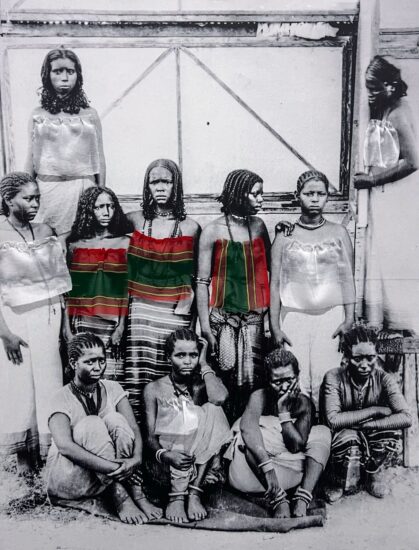
Aida Silvestri, Untitled Untitled, 2023
The Centre for British Photography Realisation Grants enable photographers and artists working with
photography to bring an ongoing project to completion within a year. In this expanded third cycle of their annual grants programme, five grants were awarded and all to female artists. The 2026 grants are awarded to:
Caroline Douglas for The Sublime Truths of Science are No Longer Confined to the Wealthy and Learned
Douglas’s project The Sublime Truths of Science are No Longer Confined to the Wealthy and
Learned disrupts this history of photographic invention. Focussing on gender, class and empire, the
project uncovers the scientific contributions of two women who conducted proto-photographic
experiments in their domestic settings: Elizabeth Fulhame (fl. 1794) and Mary Somerville (1780-1872).
Douglas’s project disrupts by combining creative archival research and contemporary photographic art practice, in particular, reenactment.
The project restages Fulhame and Somerville’s photochemical experiments, from Fulhame’s cloths of gold to Somerville’s colour anthotypes, to make a series of permanent photographic prints that
uncovers and marks women’s place in photographic invention in Britain. The grant will support print,
exhibition and publication production and related activities.
Jenny Lewis for Autoimmune x Autophoto
Lewis’s work with a photobooth responds to the overlooked perspective of autoimmune disease, often discussed in medical terms rather than the slippery psychological landscape of chronic illness. Lewis repurposed the booth to witness the experience of living in a mutinous body, to raise awareness of lives derailed and silenced. Inviting people from the autoimmune community to participate, Lewis first interviewed everyone, then invited them to confront themselves in the Photobooth’s confessional space.
The project responded to Lewis’ experience of ageing in a body disrupted by autoimmune disease, and has now gathered people with a shared language and expansive crip point of view. The grant will enable Lewis to create new work as well as support the specialised teaching process of intaglio printing and related activities.
Tomoko Nagakawa for ΔS ≥ 0 | The Weight of a Second
ΔS ≥ 0 | The Weight of a Second is a personal exploration of how we experience time, especially through the lenses of grief, aging, and memory. Time not as a straight line, but as a field of relationships — elastic, uneven, shared.
By layering and juxtaposing materials, each work becomes an object that preserves yet dissolves memory, inviting the viewer into a suspended temporal experience. The grant will support salt and silver gelatine process on paper and silk and related activities and materials.
Sophy Rickett for Riverings
Located in the landscape of South Devon’s River Teign, Riverings explores the cultural, social and environmental legacies of the region’s historic ball clay industry. The word “riverings” is defined as “the act of collecting information, stories, or materials from multiple, diverse sources into a single, cohesive or connected body, similar to how a river gathers tributaries”. As well as the literal flow of the River Teign, it reflects Rickett’s methodology, which combines documentary and staged photographic work with a written account of the artist’s archival and library research, internet searches, face-to-face meetings.
Rickett gathers photographic and text based material throughout the process, and draws them into provisional, subjective relation. The grant will support print and publication production and related activities.
Aida Silvestri for Untitled
Silvestri’s project Untitled is an autobiographical work-in-progress critically exploring personal and collective trauma, colonial violence, indigenous practices, and gender-based oppression. Collecting old postcards of Eritrea for years, Silvestri has repeatedly discovered fresh parallels between visuals of exploitation and the lived experiences of herself and the women in her family and wider community. Using archival and self-portrait photographs, it merges experimental analogue and digital techniques with tactile materials to redress past experiences, reclaim agency and encourage dialogue in the present.
Silvestri’s practice manipulates both digital and analogue imagery, combining experimental techniques with tactile materials such as fabric, beads, and a recurring red thread motif—symbolising both connection and rupture within gendered violence, inherited trauma, and colonial legacies. By re dressing semi nude bodies, a dialogue about power, consent emerges, reclaiming agency for historic subjects and foregrounding embodied and reconstituted memory. The grant will support image scanning, optimisation, preservation of the archival images as well as production, print and additional image manipulation processes and materials.
To find out more please go to the direct link.
