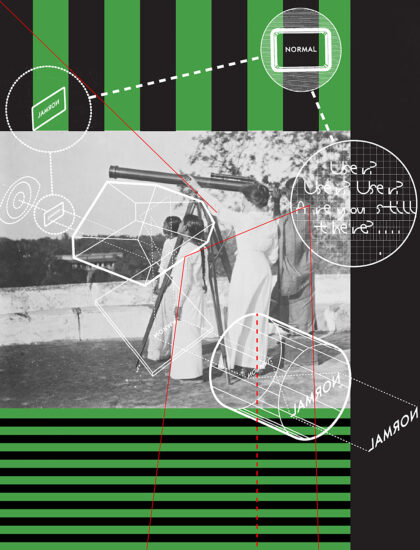
Image by Steffi Klenz from the series "Agnes Playing Leg", 2026
Symposium and Exhibition
Museum of Art & Photography, Bangaluru
September 13, 3-6:30pm
The speakers include: Suryanandini Narain, Mira Brunner, Anna Fox, Steffi Klenz and Priyadarshini Ravichandran and there will be an opening also for the exhibition during this afternoon. To register to the symposium, please go to MAP website.
The exhibition is on show at At MAP in the Sasken Multimedia Gallery from September 13 – October 30, 2026.
The Gallery-on-Demand exhibition of Archive Frictions is on view at the Museum of Art & Photography’s dedicated cultural spaces at Kempegowda International Airport, Bengaluru.
The exhibition will be shown in Scotland next year. More information will be available here soon.
Archive Frictions is delivered in collaboration with the Museum of Art & Photography (MAP), in Bengaluru, the National Galleries Scotland (NGS) in Edinburgh and Fast Forward: Women in Photography at University for the Creative Arts (UCA). The project is kindly supported by The British Council, India and The University for the Creative Arts, UK.
At the heart of Archive Frictions is a remarkable collection of photographs discovered by UCA PhD student Alexandra Gow in the archives of the National Galleries of Scotland. Believed to have been taken at the Women’s Christian College in Chennai and Kinnaird College for Women in Lahore during the early to mid-twentieth century, the images offer a rare glimpse into life at these institutions under the leadership of its principal, Isabella McNair—a British educationalist and passionate advocate for women’s rights and intellectual equality.
In contrast to the many stereotypical depictions of India present, this collection stands out for its focus on women— depicted within the uncommon context of the educational settings of the college—and for its unusually intimate photographic style. Two contemporary artists—Priyadarshini Ravichandran, based in India, and Steffi Klenz, based in the UK—have responded to the archive through the creation of new visual works.
Steffi Klenz’s new body of work, Agnes’ Playing Leg, examines how photographs register the positioning of the female body and how posture, gesture and movement are culturally and photographically shaped and controlled, while potentially expressing agency and resistance. Informed by Marianne Wex’s pioneering research into body language and patriarchy, Klenz’s new collage-based works draw attention to the unconventional postures of the female students. Their bodies appear to be quite literally ‘taking up space’, challenging normative expectations of femininity that encourage withdrawal, containment and the minimisation of physical presence.
In her project, Klenz connects biases embedded in colonial photography with those reproduced through machine vision, facial recognition and AI systems. Text generated by the female spam bot Agnes further explores the gendering of automated voices and the construction of the contemporary ‘digital woman’ within technoculture. Designed to appear helpful, compliant and endlessly available, the ‘digital woman’ reproduces familiar expectations surrounding femininity, care and invisible labour.
Priyadarshini Ravichandran new work Be Like Salt approaches the archive through speculative imagination, asking what the photographed women might have been thinking, seeing and feeling while acknowledging the impossibility of fully knowing their interior lives. Recreating archival scenes with friends and contemporaries, she uses re-enactment not as historical reconstruction but to activate relationships between past and present. Improvisation, gesture and intimacy shape moving-image works exploring possible affective continuities across generations. Women’s writing from an early twentieth-century Madras journal introduces historical female voices into dialogue with contemporary ones, allowing themes of longing, careers, gender politics and the body to circulate across time.
Archive Frictions fosters a dynamic dialogue between historical and contemporary perspectives, illuminating the evolving representation of women in photography across time and cultural contexts. The work of both Klenz and Ravichandran exposes archival silences, challenges dominant histories and transforms the archive into an active site for questioning gender, colonial legacies, representation and institutional power.
