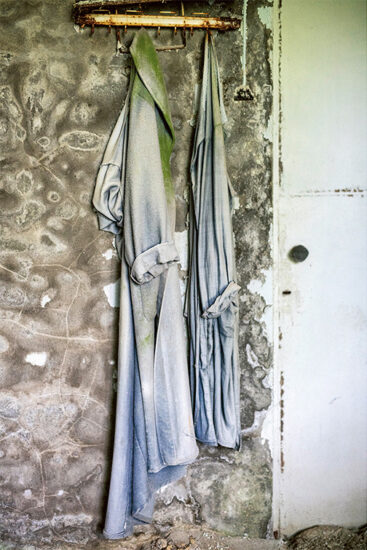
Doctors’ lab coats hanging abandoned in Prypiat Hospital no. 126, 2019 © Carsten Olsen
Radioactivity is invisible, yet popular culture insists on making it shine. From glowing objects and luminous bodies to contaminated landscapes and spectacular scenes of disaster, images of radioactive pollution have shaped how nuclear power is imagined, feared, desired and remembered.
Drawing on her doctoral research, Fannie Frederikke Baden presents Nuclear Baroque a scholarly monograph investigating the history of nuclear visual culture and how these images influence our understanding of radioactivity, disaster and a nuclear future. Today, many scholars argue that we are situated within a »Nuclear Renaissance«: a moment of renewed optimism about nuclear power as a possible solution to the climate crisis and energy insecurity. Baden, however, argues that popular visual culture tells a markedly different story. Rather than celebrating technological progress and energy utopia, it repeatedly returns to images of life next to disaster: pollution, mutation, ruin and tragedy. The nuclear glow, in this context, turns from a sign of technological and political promise into an exaggerated reminder of nuclear destruction.
Baden describes this visual language as »Nuclear Baroque«: a world of fantasy, spectacle, and excess in which the consequences of nuclear disaster become absurdly »sensible«. Such representations can make catastrophe appear both distant and unreal, and potentially obscure the environmental and technoscientific realities of nuclear power.
To find out more please go to the direct link.
