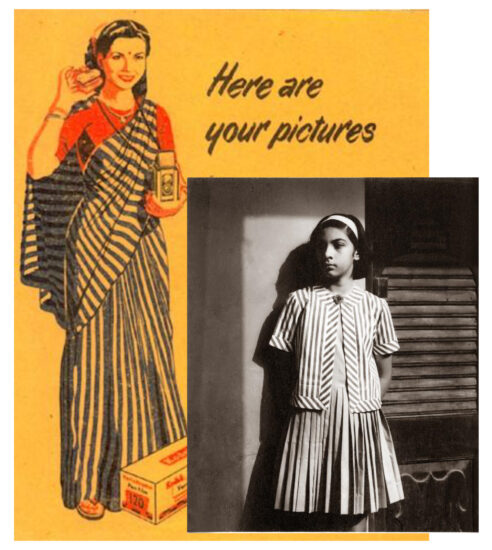
Images: Negative Jacket from Liberty Photo Flash, using Kodak Advertisement, Bhuj (Kutch), India c. 1950s. Source: From the personal collection of Rajendra Kuverba. Courtesy: Eastman Kodak Company / Manobina Roy: Portrait of Daughter Aparajita, Bombay, c.1960. Courtesy: Aparajita Sinha
The 7th Fast Forward: Women in Photography conference
The Lure of the Archive: Photographs of the Home and Heart
Call for papers is closed. The program will be announced soon.
Conference dates:
February 3-5, 2027
Venues:
Jamia Millia Islamia, Jamia Nagar, New Delhi-110025
Theatre, British Council, 17 KG Marg, Atul Grove Road, Janpath, Connaught Place, New Delhi, 110001
Fast Forward: Women in Photography announces the 7th edition of the Fast Forward conference, which is organized in partnership with A.J.K. Mass Communication Research Centre, Jamia Millia Islamia (Central University) and British Council in India.
The research project Fast Forward: Women in Photography aims to explore the work and histories of women photographers, promote opportunities and question ideas dominating the field of photography by initiating thoughtful, new debates. Initiated in 2015 with a two-day conference at Tate Modern (UK), the project has become significant within the world of photography for examining the work of women photographers and for questioning the way that established canons have been formed. Between 2017 and 2025 the editions 2 to 6 of the Fast Forward conference took place in Lithuania, the UK, Greece, Croatia and Poland.
The Digital era has prompted a new interest in archives, both material and virtual. Long-term preservation of analogue through digitization has been the most ubiquitous for both public and private archives. In many cases, material from family albums and personal collections now have public visibility in galleries, websites, multimedia projects and publications. Digitization has also inaugurated several online initiatives in which ordinary citizens scan photographs, documents and other ephemera and post these on the internet.
Inspired by Arlette Farge’s pathbreaking book, The Allure of the Archives (1989) the seventh Fast Forward conference titled The Lure of the Archive: Photographs of the Home and Heart examines the burgeoning narrative sbeyond institutionalized archives through vernacular photography, family and personal collections and online archival platforms. Geoffrey Batchen has described the vernacular as “what has almost always been excluded from photography’s history: ordinary photographs, the ones made or bought (or sometimes bought and then made over) by everyday folk from 1839 until now, the photographs that preoccupy the home and the heart but rarely the museum or the academy.” (2000, 262)*
We are interested to discover how these most familiar and at times overlooked practices of photography have been used to reshape the very idea of the archive or to draw attention to its erasures and silences. We invite proposals from curators, artists, scholars, practitioners, students and others who critically engage with the vernacular to raise new questions about the past from the vantage point of the contemporary.
Questions of interest include but are not limited to:
>> How does vernacular photography by or about women or non-binary communities inform our understanding of public and private histories in South Asia and beyond?
>> How have social media and online platforms promoted an interest in vernacular photography and what sort of projects have gained momentum through the internet?
>> How have museums and galleries responded to these familiar, overlooked and everyday forms of photography in a contemporary moment?
>> What changes with the shifts in the material practice, exhibition and circulation of analogue material in a digital moment?
>> How have contemporary artists interrogated the domain of the personal?
>> How could we interpret unruly images that slip out of their everyday context to become orphaned?
>> How does revisiting the vernacular challenge formations of the normative and offer insights into silenced, repressed, overlooked or under-represented identities?
>> What kinds of methodologies might be used to trace or imagine obliterated and absent histories?
There will be no conference fee.
Papers will be considered for publication in an established academic journal.
*Geoffrey Batchen. (2000). Vernacular photographies, History of Photography, 24:3, 262-271
Organizing Committee:
Prof Sabeena Gadihoke (AJK Mass Communication Research Centre/Jamia Millia Islamia)
Prof Anna Fox (Fast Forward / University for the Creative Arts)
Maria Kapajeva (Fast Forward / University for the Creative Arts, Estonian Academy of Arts)
Dr Caroline Molloy (Fast Forward / University for the Creative Arts)
