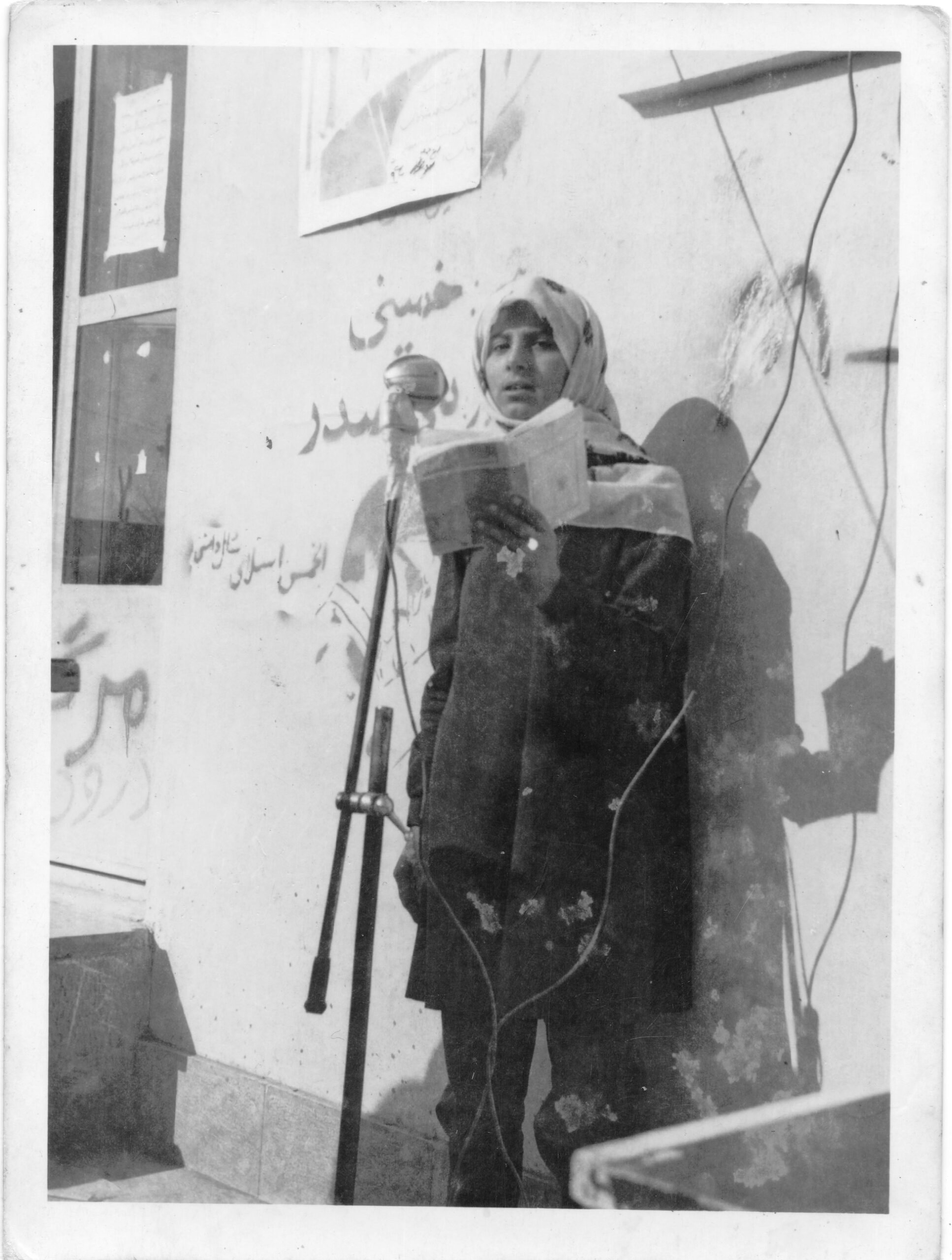
A visual exploration of history: Looking for my mother in the archives of a nation
This practice-based research examines how ideological narratives are constructed, transmitted, and sustained across four interconnected forms of archive: state archives, independent photographic archives, family photographic archives, and the body as a living archive. Drawing on visual and cultural studies, political philosophy, photographic theory, and feminist research, it understands the archive not as a neutral repository but as an ideological structure that produces political beliefs, memory, emotional attachment, and identity.
Focusing on post-revolutionary Iran, the research analyses state-produced propaganda alongside independent and vernacular photographic archives documenting events from before the 1979 Revolution to contemporary protest movements. It also examines my family’s photographic archive across three generations of maternal women, my grandmother, my mother and myself, and explores the body as a living archive through which ideology is embodied in lived experience and intergenerational relationships.
The methodology combines archival research, archival reconstruction through collage and montage, participatory workshops with Iranians living outside Iran, ethnography, and autoethnography. Through these methods, the research investigates the relationships between state archives, photographic archives, family archives, and embodied memory, employing artistic practice to challenge dominant historical narratives and, ultimately, to examine how the body itself functions as a living archive through which ideology, initially constructed by state power, is embodied, transmitted, reproduced, and sustained.
The research argues that the Iranian Revolution and its aftermath cannot be fully understood solely through post-memory frameworks because the ideological system established after 1979 remains active in the present. It contributes new knowledge by examining the interconnected mechanisms through which ideology persists across institutional, familial, and embodied domains.
Zohreh Mohammadhosseinpour’s research is supervised by: Professor Anna Fox (Professor of Photography, UCA Farnham); and Dr Caroline Molloy (MA Photography Lead & Research, Knowledge Exchange and Innovation Lead, School of Creative and Cultural Arts, UCA Farnham)
